
I am in two minds about graffiti.
Sometimes it is just senseless destruction of beautiful facades but more and more it gives voice to a neighborhood in change and transforms organically into art from Banksy and beyond. Graffiti stretches back through the ages. It comes from the Italian word “graffiato” which simply means scratched. It really starts like a primitive text message that hasn’t been deleted or expunged from the memory of the ages and it pops up on everything, especially Roman (usually with a clear statement and cause). It is found in Egypt, in Pompeii, in the ruins of Greece and Turkey, and in the tiny odd corners of Rome.
Recently in Rome, I took a little excursion based on an article I read in one of my favorite magazines, The World of Interiors. I headed to Testaccio which is close to the Protestant cemetery where Keats is buried and the Pyramid of Cestius by the Porta San Paolo. The pyramid is actually the only surviving Egyptian pyramid in Europe. It was built around 18 BC by some mad egomaniac who thought he was a pharaoh. Ego was in high supply during that period.
Testaccio, the Roman neighborhood that sits just behind the pyramid, is going through a bit of a Renaissance. New restaurants are popping up around what used to be the ancient Roman rubbish heap on the Eastern banks of the Tiber, now known as the Monte Testaccio. It developed some notoriety in the 1950’s when the filmmaker Paolo Pasolini sat at the top of this rubbish heap of remnants of old roman vessels that carried olive oil for a photograph. Now this area is a mix of trendy, bohemian, and authentic Roman.
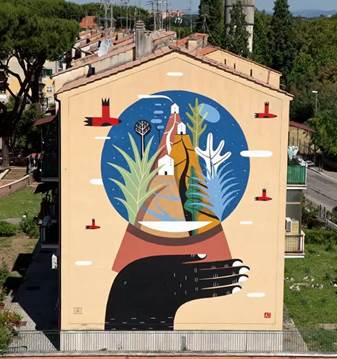
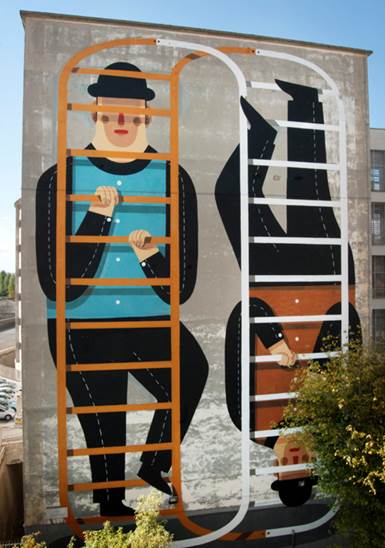
My friend and fabulous Roman guide, Carlotta Boldrini, lives around the corner from here. Her hood now boasts a new painter on the block. The article was about these huge murals by Agostino Iacurci. While former markets and factories in Ostiense and Testaccio are transforming into trendy, gentrified eateries, cafes, bars, and apartments, this wonderful artist has pulled together the scruffiness and the neglect of a rundown neighborhood in the process of change and intertwined it with his sensational murals.
“As an artist, working outside deprives me of that air of sacredness that you associate with works in a museum,” he says.
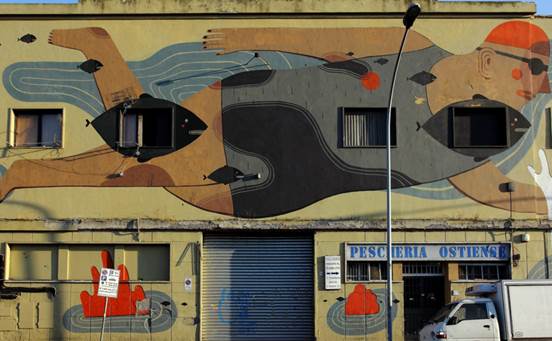
Agostino takes on the role of integrating his art into the neighborhoods in spectacular fashion. His art is big and sits above everyday Rome with warts and all. His murals are as offbeat as a swimmer with cap and goggles above a fish shop. His equipment is simple: A sponge roller, a cherry picker and simple masonry paint. One day maybe some 2,000 years on, we will find some faded fresco by a huge skyscraper near a tiny pyramid and lament that Rome was once a city that you could walk around and get a decent coffee in a neighborhood bar.
I love how you trace graffiti’s history from ancient Rome to modern artists like Banksy. It’s fascinating how this art form evolves. Speaking of modern takes, I recently tried an ai graffiti generator that lets anyone create photorealistic street art designs digitally. It feels like a natural extension of that creative tradition!
I love how you trace graffiti’s history from ancient
I love how you trace graffiti’s history from ancient Rome to modern street art. The examples from Pompeii were fascinating – it really shows how the human impulse to leave a mark hasn’t changed in 2000 years. Your comparison to contemporary artists like Banksy makes the continuity so clear. This historical perspective adds so much depth to understanding graffiti as cultural expression rather than just vandalism.
Fascinating dive into Roman graffiti! I had no idea the Romans were so prolific with wall inscriptions – from political slogans to love notes, it feels surprisingly modern. Your photos of the preserved examples are wonderful. It makes you think about what future archaeologists might make of our own street art and tags 2000 years from now.
Thanks for connecting ancient Roman wall writing to today’s graffiti culture. The detail about how common people used graffiti to voice opinions in the forum really resonated. It’s not so different from how people use public art now to make social commentary. Great historical context and excellent writing!
Your exploration of Roman graffiti as early social media is brilliant. I especially liked the part about election notices scratched on walls – such a direct ancestor to today’s posters and tags. The way you show graffiti as a historical record makes me appreciate modern street art even more. Looking forward to exploring those Roman sites myself!
Brilliant post connecting Roman graffiti to modern expression. The idea that Romans used walls to comment on daily life, politics and even sports team rivalries makes ancient Rome feel very alive. Your writing really brings those faded inscriptions back to life. I will look at street art differently after reading this!
Thanks for this thoughtful piece on Roman graffiti. I never considered how much these ancient scratches reveal about everyday Roman life beyond the grand monuments. The anecdote about lovers’ messages surviving millennia is really touching. It makes the past feel personal and immediate.
What a wonderful perspective on graffiti history! I loved learning that the word comes from graffiato meaning scratched – such a humble origin for something that now covers city walls worldwide. Your tour of Egyptian, Pompeian and Greek examples shows how universal this impulse is. Thank you for sharing this journey!
Enjoyed your deep dive into Roman graffiti! The parallels you draw between ancient scratched messages and today’s tags are spot on. It’s amazing to think that ordinary people have been claiming public space for personal expression for thousands of years. Your photos really helped visualize the history.
Thanks for this insightful look at Roman graffiti. I appreciated the explanation of how graffiti served as informal news and humor for everyday Romans. It makes the ancient city feel less like a museum and more like a living neighborhood. Great piece with wonderful details!
Really enjoyed reading about the Roman habit of scratching messages on walls. It’s incredible that even casual jokes and bar tabs survived Vesuvius to tell us about daily life. Your photos from the Roman sites are fantastic – thank you for bringing history down to street level!
Fascinating article on Roman graffiti! Your point that graffiti is essentially a primitive text that survived the ages really struck me. I loved the examples from Rome’s back streets and how they reveal personal stories, not just official history. Makes me want to wander Rome with new eyes!
I love how you frame Roman graffiti as unfiltered voices of the people. Unlike official inscriptions, these scratched notes feel spontaneous and human – complaints, declarations, silly drawings. It really changes how I think about ancient history, not just emperors but everyday Romans talking to each other.
Great read on Roman graffiti origins! I was intrigued by how you trace the word to graffiato and show its spread from Egypt to Pompeii. The idea of graffiti as a democratic historical archive is powerful. Your recent Roman excursion sounds like a perfect way to see it firsthand!
Thanks for shedding light on Roman graffiti culture. The fact that everyday complaints and jokes were scratched into walls makes ancient Rome feel much more relatable. I especially enjoyed the section on Pompeii – those preserved messages are like time capsules. Wonderful writing and photos!
Thanks for bringing Roman graffiti to life! The way you link the Italian graffiato tradition to today’s street art makes the continuity so tangible. I found the comparison to Banksy and the idea of graffiti giving voice to a changing neighborhood especially compelling. Beautifully written!
Thanks for connecting ancient Roman wall writing to today’s graffiti culture. The detail about how common people used graffiti to voice opinions in the forum really resonated. It’s not so different from how people use public art now to make social commentary. Great historical context and excellent writing!
Brilliant post connecting Roman graffiti to modern expression. The idea that Romans used walls to comment on daily life, politics and even sports team rivalries makes ancient Rome feel very alive. Your writing really brings those faded inscriptions back to life. I will look at street art differently after reading this!
Thanks for this thoughtful piece on Roman graffiti. I never considered how much these ancient scratches reveal about everyday Roman life beyond the grand monuments. The anecdote about lovers’ messages surviving millennia is really touching. It makes the past feel personal and immediate.
Thanks for connecting ancient Roman wall writing to today’s graffiti culture. The detail about how common people used graffiti to voice opinions in the forum really resonated. It’s not so different from how people use public art now to make social commentary. Great historical context and excellent writing!
Brilliant post connecting Roman graffiti to modern expression. The idea that Romans used walls to comment on daily life, politics and even sports team rivalries makes ancient Rome feel very alive. Your writing really brings those faded inscriptions back to life. I will look at street art differently after reading this!
Thanks for this insightful look at Roman graffiti. I appreciated the explanation of how graffiti served as informal news and humor for everyday Romans. It makes the ancient city feel less like a museum and more like a living neighborhood. Great piece with wonderful details!
I love how you trace graffiti’s history from ancient Rome to modern artists like Banksy. It’s fascinating how this art form evolves. Speaking of modern takes, your piece really highlights the line between destruction and art in a changing neighborhood. Thanks for the deep history!
Fascinating dive into Roman graffiti! I had no idea the Romans were so prolific with wall inscriptions – from political slogans to love notes, it feels surprisingly modern. Your photos of the preserved examples are wonderful. It makes you think about what future archaeologists might make of our own street art and tags 2000 years from now.
Thanks for connecting ancient Roman wall writing to today’s graffiti culture. The detail about how common people used graffiti to voice opinions in the forum really resonated. It’s not so different from how people use public art now to make social commentary. Great historical context and excellent writing!
Brilliant post connecting Roman graffiti to modern expression. The idea that Romans used walls to comment on daily life, politics and even sports team rivalries makes ancient Rome feel very alive. Your writing really brings those faded inscriptions back to life. I will look at street art differently after reading this!